Reflection 3: Artificial Intelligence, Academic Integrity, and More
This week in EDCI 136, our learning focused on Generative AI, academic integrity, and the ethical considerations surrounding AI usage in education. We explored how AI tools are evolving, their implications for students and educators, and strategies for effectively integrating them into learning.
Lucas Wright’s Lecture:
Lucas Wright’s Lecture titled, Generative AI: A Sea of Change was very interesting and it was cool to learn so much about AI.
The first thing that caught my attention in this lecture was a statistic Lucas shared: “59 per cent of 423 Canadian students surveyed use generative AI in their schoolwork, compared to 52 per cent in 2023.” This surprised me, as I thought the number would be higher. However, he mentioned that he expects the real number to be much higher now.
Another key takeaway was seeing how generative AI scores on school exams and how much it has improved over time.
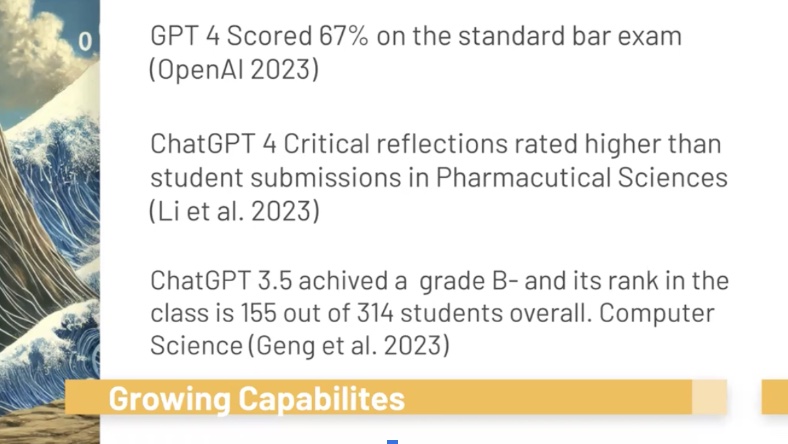
Photo from Lukas Wright’s Lecture
This makes me curious to see how much AI will improve a year from now, given how fast it is evolving.
One of the most interesting concepts was that AI is 100% confident in its outputs but only about 70-80% accurate. This resonated with me because I learned the same thing in my COM 200 course last semester. Another surprising fact was that AI checkers are not very accurate, with only about a 34% effectiveness rate—and that number is declining.
Discussion with Valerie Irvine and Lucas Wright
In the lecture where Valerie and Lucas discussed Lukas’s lecture and talked more about AI one of the coolest things I learned was that you can create different GPTs tailored to specific needs. Before this lecture, I had never used custom GPTs, but after learning about them, I started creating my own. So far, I have built:
- A grammar checker that reviews my work without changing my words, focusing solely on grammar.
- An email responder similar to the one Lucas shared. It breaks down the email, explains what the sender is asking, prompts me for a response, and then generates a professional and concise reply.
This was one of my favorite discoveries of the week!
Miriel Miller’s Lecture
Miriel Miller’s Lecture was very interesting and I learned a lot about using AI in education. The first statement that stood out to me was: “If you go to AI first, you are using it too much. You are taking courses to learn.” This really stuck with me and reminded me to ensure that I’m using AI as a tool rather than letting it do the thinking for me.
Another key insight was the idea that setting goals for how I use generative AI can help me ensure that I am leveraging it in a way that aligns with my learning objectives. This is something I want to implement in my own academic work.
Final Thoughts:
This week’s content has been my favorite so far! Learning about AI in depth has been really interesting, and I gained so many new insights. My favorite tool was discovering the different GPTs I could create, which I first learned about in Lucas’s lecture. The most surprising thing I learned was about the environmental impact of AI. I had never considered the resources AI consumes, and this is something I will definitely think about more when using it in the future.